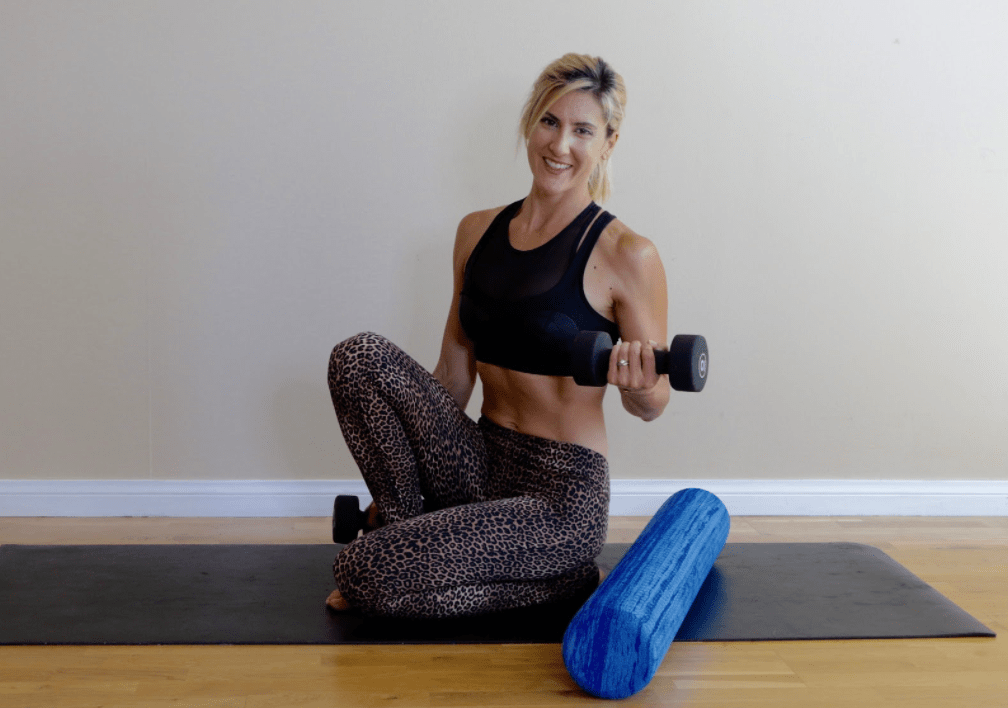

hammer curl
A variation on the bicep curl in which a neutral grip
is used throughout the movement, which transfers more
force onto the brachioradialis by reducing the leverage
of the biceps at the top of the movement.
hams,
hamstrings
The grouping of muscles of the back of the leg. The
hamstrings include the biceps femoris, semimembranosis,
and semitendonosis. See...exercises
for hamstrings.
head,
muscle head
A 'head is the actual individual of a group
of muscles. The biseps has 2 heads and is actually 2
muscles. The triceps has 3 heads, 3 muscles. Often the
multiple heads of a single muscle will attach to different
bones on either side of a joint. The calf muscle has
two heads, which connect at the bottom and attach to
the heel: the , the top of which attaches above the
knee joint, and the soleus which attaches below.
Because of this, if the knee is bent (such as when performing
seated calf extensions the gastrocnemius is put in a
poor position to transfer force and the exercise is
performed largely by the soleus head.
HMB, HydroxyMethylButyrate
a metabolite of the branched-chain amino acid leucine,
HMB is also available in supplement form. Some studies
have shown increased growth in cattle given HMB, but
evidence of any value for increasing human muscle growth
and athletic performance is limited.
homeopathic
traditionally, a philosophy of therapy in which medical
conditions are treated by preparing a solution of a
substance which produces symptoms similar to those produced
by the condition, diluting it until no molecules of
the active ingredient remain in the solution, and then
drinking it. The term is often applied to any solution
so prepared, and irrespective of whether the homeopathic
solution is intended to cure or cause a particular reaction,
it is an expensive technique for consuming small quantities
of water.
While it is not obvious why one would wish to do this,
it does have the advantage of relatively few side effects.
hydrogenated fat
see 'fat'
hyperextension, hyperextensions
hyperextension"
refers to bending it beyond its normal range of motion
(usually this is bad).
as an exercise, "hyperextensions" are performed
using a roman chair which supports one's legs and hips
in a horizontal, prone position. Either with or without
a weight, one then bends at the hips, lowering one's
head and shoulders until one's torso is close to vertical.
Then, by contracting the glutes and spinal erectors
, one raises one's torso back upwards to above the horizontal.